
A travel eSIM can cost much less than daily roaming when you mainly need maps, messaging apps and mobile data. Home-carrier roaming is often simpler if your plan already includes the destination or you need ordinary calls and texts on your U.S. number. Compare what your existing plan covers before buying either option.
This travel eSIM vs international roaming guide is for U.S. consumers, with prices in USD checked October 21, 2026. It uses current carrier and phone-maker documentation, not personal travel tests. The cheapest data package is not necessarily the cheapest way to keep every service you need working.
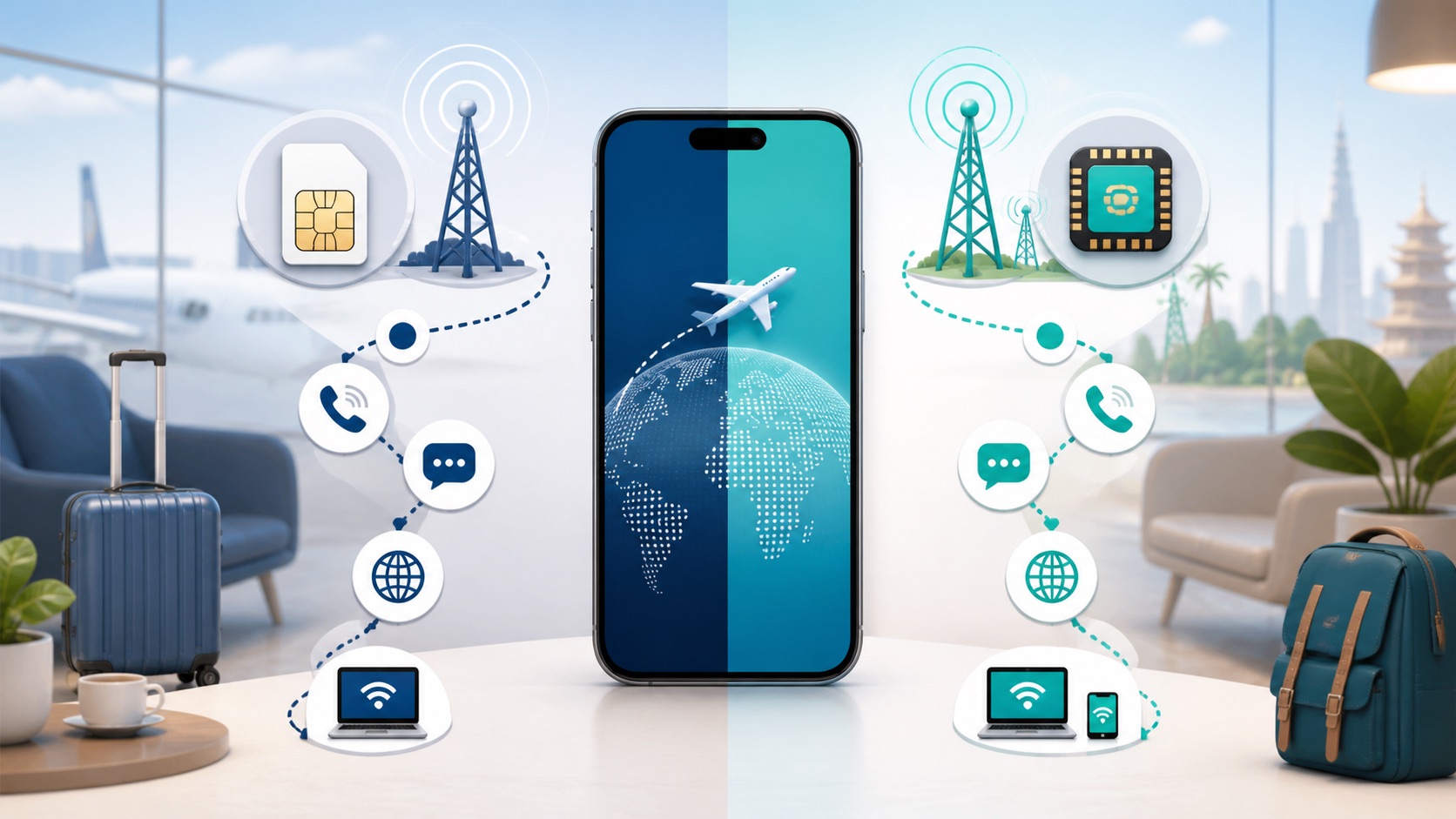
A travel eSIM is a second plan, not a replacement for every phone service
With international roaming, your home carrier supplies service through its arrangements abroad. A travel eSIM adds a separate digital SIM plan to a compatible phone. Your home carrier can also use an eSIM, so the choice is really between service plans, not digital versus physical SIM technology.
| What you need | Home-carrier roaming | Separate travel eSIM |
|---|---|---|
| Data for maps and apps | Included only under your plan or travel add-on’s terms | Uses the purchased allowance in supported destinations |
| Ordinary calls and SMS on your U.S. number | Can keep your existing line working, subject to charges | A data-only package does not supply that service |
| A locked phone | May still roam with its home carrier | Must be unlocked to use a different carrier |
| Laptop hotspot access | Check the domestic plan and roaming terms | Check the specific package; do not assume it is allowed |
First open your carrier account and check the exact countries, data allowance and calling rules already included. A paid pass may add nothing useful if your existing benefits cover the trip. If you use a smaller provider, read that provider’s terms rather than assuming the host network’s AT&T, Verizon or T-Mobile travel offer applies.
Current U.S. roaming costs: daily passes can add up
These are add-on costs, not replacements for your normal U.S. phone bill. They require eligible service and an included destination. Check applicable taxes, fees and any travel credits before treating the displayed amount as your final bill.
| Option checked | Published service price | Important limit |
|---|---|---|
| AT&T International Day Pass | $12 per charged day for the first line on land; $6 for additional lines on the same account used the same calendar day | Consumer land/air daily-fee cap is 10 per line per bill period, not per trip |
| Verizon TravelPass | $12 per used day in most TravelPass destinations; $6 in Canada/Mexico if not included in your plan | 5GB high-speed data per session, then data at 3G speeds for the rest of that session |
| T-Mobile International Pass | $10 for 2GB/24 hours; $50 for 15GB/up to 10 days; $75 for 30GB/up to 30 days | Qualifying postpaid plan; the allowance is for the pass, not a fresh allowance each day |
AT&T’s Day Pass explanation separates land and air from its $20-per-day sea service. A trip crossing two bill periods can incur charges in both; the 10-fee cap is not a blanket $120 maximum for any length of vacation. Calls, outgoing texts or background data can start a chargeable period.
Verizon’s full TravelPass answers also warn that background syncing and app updates can start a 24-hour session. Check included international benefits or available TravelPass days before paying the daily rate. Wi-Fi calling to countries other than the U.S. has separate international long-distance rules.
T-Mobile’s current International Pass page includes calling and permits its high-speed pass data to be used as a hotspot. After the allowance, data slows according to the plan. Only one pass can be active; starting another ends the remaining benefits of the first. Choose a start date when adding it or it starts immediately.
A seven-day cost example, with the differences left visible
Seven charged $12 sessions cost $84 for one line before applicable extras. That arithmetic applies to the daily rate, not to a traveler who already has included roaming or usable credits. T-Mobile’s $50 10-day pass is a different allowance and can cover a seven-day trip where eligible.
For a concrete travel-eSIM example, Airalo’s France 5GB, seven-day package displayed a $10 total when checked. It is data-only, covers metropolitan France and Corsica, and excludes Monaco and French overseas territories. Its seven-day validity starts when it connects to a supported network in the coverage area. That is a specific package, not a worldwide price or a recommendation based on testing.
The $10 package and $84 of daily roaming do not buy identical services or data allowances. Add any top-ups and home-line charges to the eSIM cost. If you keep using the U.S. line for calls, you could pay for the travel package and still trigger a carrier day pass. Airalo also offers optional automatic renewals when 10% of data remains; check whether that option is enabled.
For two people, price each line separately and check family discounts. Do not multiply one advertised first-line rate across everyone without checking the rules. Our plan-fee checklist helps separate the service price from conditional charges.
Can you keep your U.S. number for texts?
You can keep a home line active alongside a travel eSIM on a supported dual-SIM phone, but the home line’s billing rules still apply. A data-only travel package does not give your U.S. number free ordinary calls or SMS. Internet messages such as iMessage are different from carrier texts and bank verification codes.
AT&T says received texts are rated as domestic and do not start a Day Pass fee. Do not generalize that rule to every carrier or to answering a call, sending a text or using data. If you need verification codes, ask your carrier exactly how to receive them abroad without unwanted usage, and set up another approved account-recovery method before leaving.
Turning off data roaming on the home line is useful, but it does not make every other use free. If you turn the line off entirely, do not expect ordinary calls or SMS to arrive through it. Decide which matters more for the trip: keeping that number reachable or preventing home-line usage.
Set up the data line before you leave
On iPhone, Apple’s international eSIM guide says to check Settings > General > About for No SIM Restrictions beside Carrier Lock before using another carrier. Confirm the exact regional phone model supports the travel provider, and install with a reliable connection after reading that package’s activation policy.
With iOS 26 or later, a travel prompt can offer Travel eSIM Only or Travel eSIM and Current eSIM. Apple warns that keeping both can still incur home-eSIM roaming fees. You can also select the intended data line under Settings > Cellular > Cellular Data. Review Apple’s per-line and data-switching settings; these controls do not replace checking your carrier’s charges for calls and texts.
On Pixel, Google’s dual-SIM instructions separate default data, calls and texts under Settings > Network & internet > SIMs. Available combinations depend on the model and carrier. Check the device’s actual controls; menus differ across Android phones.
Before paying, confirm destination coverage, hotspot permission, the start of validity and what happens when data runs out. Save installation instructions and support details somewhere you can reach offline. Do not delete a working eSIM to troubleshoot unless its provider confirms you can reinstall it.
Which option fits your trip?
Start with included roaming when it covers the countries and usage you need. Price a carrier pass next if normal calls, your home number and less setup matter more than the lowest data-only cost. Compare a travel eSIM if you mainly need internet access and have an unlocked compatible phone.
If you travel often enough to reconsider your U.S. plan, compare its recurring bill as well as travel benefits. Our Google Fi versus Mint Mobile comparison covers that broader plan choice. For this trip, write down the complete cost and which line handles data, calls and texts before boarding.